There is a moment every enterprise AI project reaches sooner or later. The pilot looks clean. The demo impresses. The outputs are fluent, formatted, and professional. And then someone who knows the source material looks closely — and realises the answer is wrong.
At Ayudh, we have seen this moment more times than we would like. Not because the AI is unintelligent. But because intelligence applied to bad input produces confident-sounding nonsense.
This is the document problem. And in India, it is larger than most enterprise technology teams anticipate.
The Indian Document Reality
India's enterprise document landscape is genuinely unlike anything most AI systems are designed for. Government correspondence arrives in Hindi, often a mixture of typed and handwritten fields on the same page. Regulatory filings carry reference numbers formatted in ways that differ by department, state, and year. Supporting paperwork for applications — loan files, compliance submissions, vendor onboarding packs — is routinely scanned at varying quality, sometimes stamped over, sometimes folded and re-scanned.
For institutions processing volume — banks, NBFCs, insurance companies, large legal and compliance teams — this is not an edge case. It is the daily reality of operations. Hundreds of thousands of documents per month, each requiring extraction, verification, and routing.
The reasonable assumption is that a sufficiently capable AI system can handle this. That assumption is where projects go wrong.
A Letter, a Reference Number, and a Revealing Test
Early in building Ayudh's document intelligence layer, the team ran a test that has since become something of a benchmark for how they explain the problem to clients.
The document: a Hindi government letter from late 2023, concerning stalled real estate projects in Noida. Eight pages. Mostly typed. Handwritten fields at the top — including the official reference number.
The same letter was processed two ways.
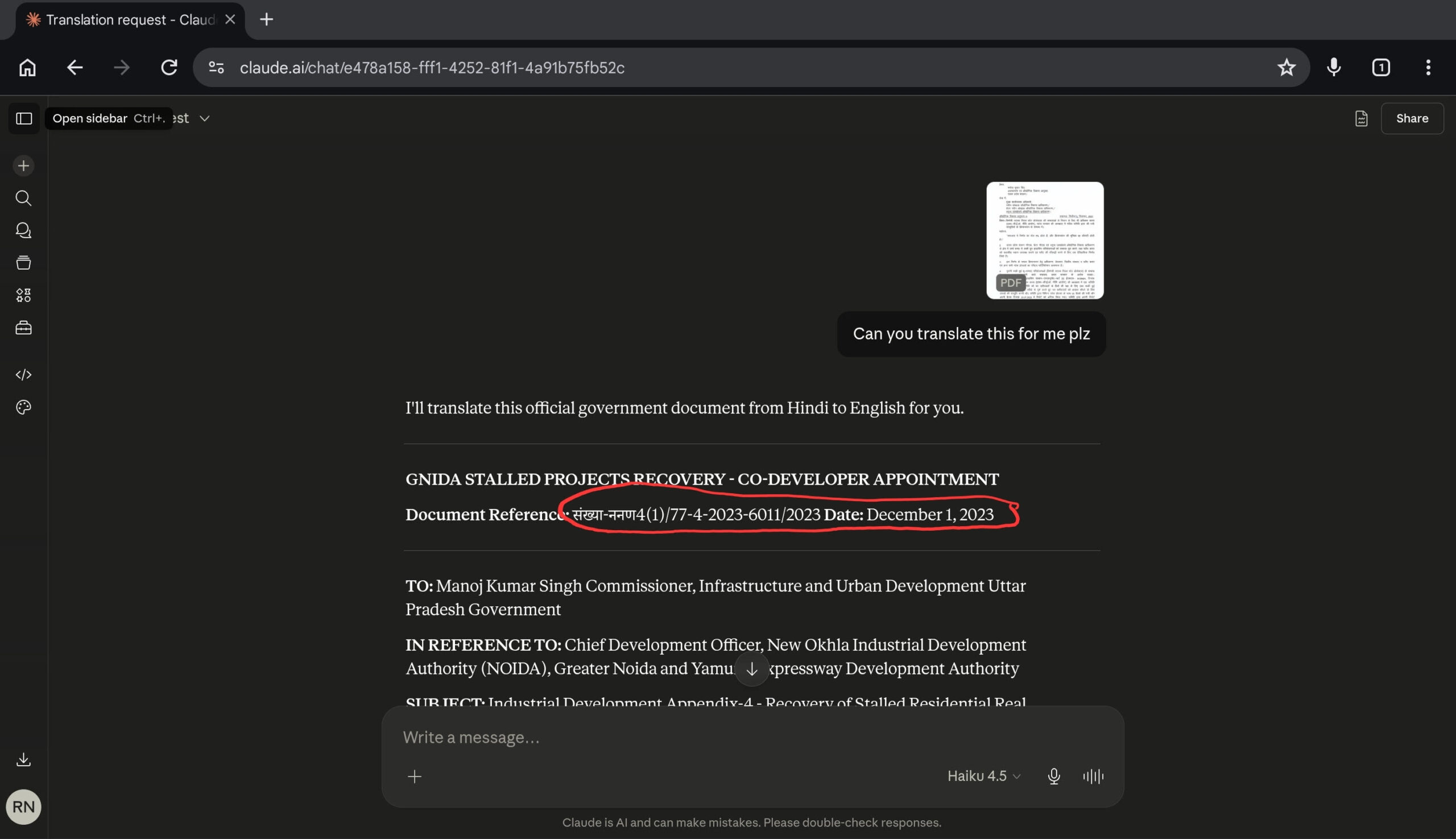
The first approach used a capable, well-regarded AI system fed the scanned document directly. It returned a formatted, professional-looking output. The reference number it extracted read: संख्या-ननण4(1)/77-4-2023-6011/2023.
The Hindi was left untranslated. The handwritten numeral — which any human reading the page would recognise as 7774 — had been rendered as garbled Devanagari characters. The output was polished. It was also wrong.
The second approach ran the same document through Ayudh's pipeline before extraction. The output: No.7774/77-4-2023-6011/2023.
Right number. Right language. Right format for downstream use.
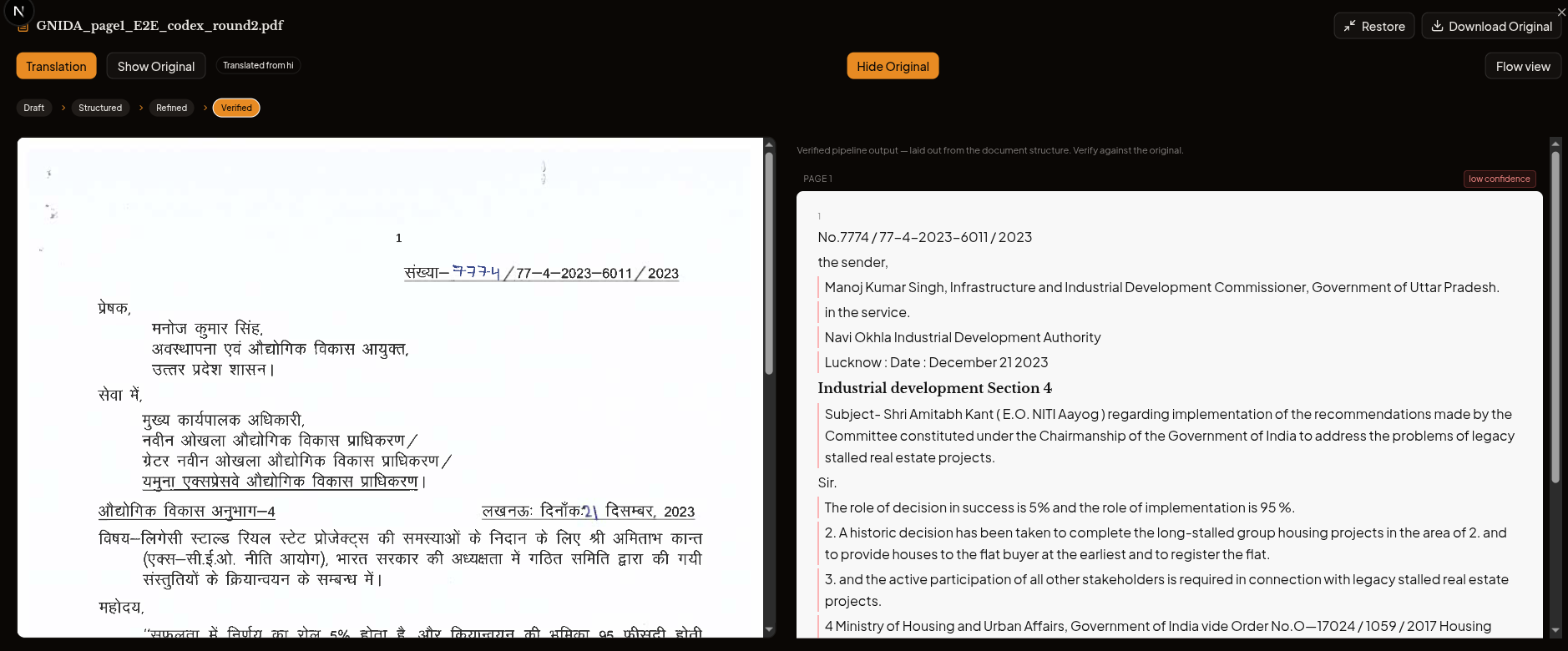
The gap between these two outputs is not a gap in intelligence. It is a gap in preparation.
What This Actually Tells You About AI in Document Workflows
The instinct, when AI produces a wrong answer, is to look for a smarter AI. A more capable model. A better prompt. More sophisticated technology.
That instinct leads teams in the wrong direction.
What the reference number test shows is that retrieval quality — the quality of what you feed the AI — matters more than model sophistication in almost every real document scenario. A highly capable system given raw, unprocessed input produces a confident, fluent, wrong answer. A more modest system given clean, correctly prepared input produces the right answer.
This is not an argument against using capable AI. It is an argument for understanding where the work actually happens.
In document-heavy workflows, especially those involving Indian languages, mixed scripts, handwritten fields, and scanned formats, the preparation layer is where accuracy is won or lost. The AI system downstream is only as good as what arrives in front of it.
The Human-in-the-Loop Problem
Many organisations, when they hear about AI making errors in document processing, reach for the same solution: keep a human in the loop. Have a reviewer check the AI's output before it acts on anything.
This is reasonable in principle. In practice, it fails in a specific and dangerous way.
When an AI system produces output that is well-formatted, grammatically correct, and plausible-looking, human reviewers do not scrutinise it the way they would scrutinise a clearly garbled output. They read it. It looks right. They move on.
The reference number in the first test above — संख्या-ननण4(1)/77-4-2023-6011/2023 — looks like a plausible government reference number to someone who is not intimately familiar with the specific document and its handwritten field. It has the right structure. It has the right visual weight. A reviewer under volume pressure, processing dozens of such outputs in a session, will pass it.
This is the specific danger of AI errors in document processing: the outputs that are wrong often look more authoritative than the ones that are right. Garbage in, garbage out — but the garbage now comes dressed in a suit.
Human review catches errors when errors are visible. It does not reliably catch errors that are fluent.
What Real Guardrails Look Like
If human review is not the answer, what is?
At Ayudh, the conclusion we have reached — and built toward — is that guardrails have to live in the document layer, not in the output layer.
That means a few things in practice.
First, the system must understand the document before it tries to extract from it. Not every scanned PDF is alike. A Hindi government letter, a GST invoice, a loan sanction letter, and a court order are different objects with different structures, different field conventions, and different error modes. Processing them identically produces consistently mediocre results across all of them. Processing them with document-type-specific logic produces results that are actually reliable.
Second, extraction has to be bounded. An AI system that can return anything — any format, any answer, any interpretation — is a system that will eventually return the wrong thing with high confidence. Systems that extract against defined schemas, that know what shape a valid reference number takes and refuse to output something that does not fit, fail loudly when they fail. That loud failure is a feature. Silent, fluent failure is the danger.
Third, extracted values should be verifiable against something external where possible. Reference numbers, registration identifiers, entity names — these can often be cross-checked against registers, databases, or prior records. A system that extracts and immediately cross-checks is catching its own errors at machine speed, before any human sees the output.
And fourth, the system must know what it does not know. A document processing system that refuses to extract when it cannot do so reliably — that returns "unable to determine" rather than a plausible guess — is a more trustworthy system than one that always returns an answer. Refusing is not failure. Guessing, at scale, in enterprise workflows with compliance consequences, is failure.
The Stakes in Indian Enterprise Document Processing
This is not an abstract technology question. For Indian enterprises dealing with volume document workflows, the consequences of getting this wrong are operational and regulatory.
A wrong reference number in a correspondence trail means follow-up letters go to the wrong file. A misread entity name in a compliance submission means a mismatch that surfaces at audit. A garbled loan application reference means a customer's file is effectively lost until someone manually reconciles it. At the volumes that large institutions operate — hundreds of thousands of documents per month — even a small error rate compounds into significant operational cost and regulatory exposure.
The lesson is not to avoid AI in document workflows. The lesson is to build the document layer with the same rigour you would bring to any critical data pipeline — because that is what it is.
What We Have Learned
Ayudh was built, in part, because the founders saw this problem clearly and believed it had not been adequately solved for the Indian enterprise context.
The insight that drives the platform is simple: document intelligence is not a model problem. It is a data preparation, structure, and verification problem. A more powerful AI sitting on top of poor document handling does not fix the problem — it makes the failures harder to spot.
What enterprises need is not a smarter extractor. They need a layer that takes messy, multilingual, handwritten, scanned Indian documents and produces clean, verified, schema-bound data that downstream AI and human processes can actually rely on.
That is the work. The Hindi letter test is a small illustration of it. But for anyone who has sat in an operations meeting trying to explain why an AI-generated output was wrong when it looked so right — it is not a small problem.